

Blog

Signature Lawn and Landscape LLC

Top Fresh Peeled Garlic Suppliers for Global Buyers?

Global buyers are reassessing Fresh Peeled Garlic suppliers as foodservice, ready-meal, and processing demand expands. The product saves labor, reduces kitchen waste, and supports consistent portion control. Yet supplier quality varies sharply.

FAOSTAT identifies China, India, Spain, and the United States among the leading garlic-producing markets. Trade data under HS 070320 covers fresh or chilled garlic, but it rarely separates peeled products. That limitation matters. Buyers should not treat broad garlic statistics as direct evidence of peeled-garlic capacity. The USDA Foreign Agricultural Service also tracks garlic production, trade, and market conditions, offering useful context for seasonal sourcing decisions. However, reports may not capture private processing volumes or short-term factory disruptions.

Reliable supplier selection requires more than a competitive quotation. Examine peeling methods, cold-chain records, harvest timing, and production-line hygiene. Ask for microbiological testing, pesticide-residue documentation, allergen controls, and traceability records. A strong supplier can identify the farm lot, processing date, packing room, and shipment temperature. Small details reveal operational maturity.

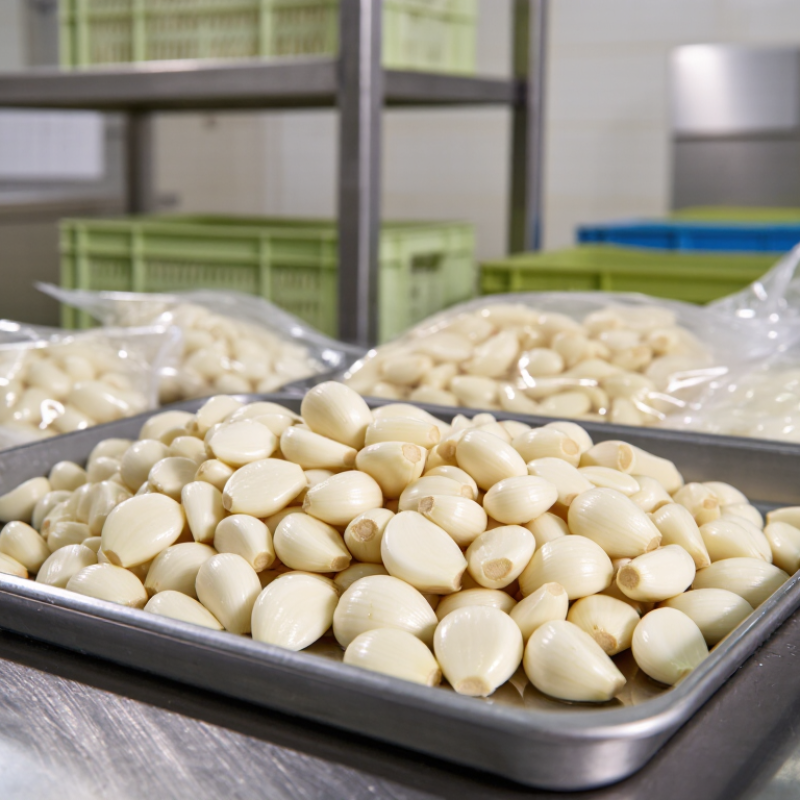
Look closely at the cloves. They should appear firm, clean, evenly peeled, and free from excessive moisture. Packaging should protect against crushing while maintaining ventilation. This is where many sourcing plans become too optimistic. A supplier may offer attractive pricing but lack stable backup capacity during weather disruptions or port delays. Buyers should compare audited facilities, sample results, minimum order quantities, shelf-life guarantees, and Incoterms before signing contracts. The following guide evaluates leading Fresh Peeled Garlic suppliers through production capability, export experience, food-safety controls, and buyer reliability. Evidence matters more than marketing claims.
Top Fresh Peeled Garlic Suppliers for Global Buyers?

What Fresh Peeled Garlic Is and Why Global Buyers Choose It

Fresh peeled garlic is made from mature bulbs whose outer skins and clove coverings have been removed. The cloves remain raw, firm, and ready for cooking. This format reduces peeling waste and keeps kitchen preparation cleaner. It also exposes quality problems quickly. Soft cloves, bruising, discoloration, or a sour smell should not pass inspection.

FAOSTAT recorded global garlic production above 28 million metric tons in 2022. That large supply supports year-round sourcing, but production volume does not guarantee dependable quality. Global buyers often choose peeled garlic to reduce labor, improve portion consistency, and shorten preparation time. A foodservice kitchen can move cloves directly from a chilled carton to a cutting board. That small step can save hours across a busy week. It can also create false confidence.

The International Trade Centre tracks garlic trade under HS code 070320, covering fresh or chilled garlic. Buyers should confirm whether shipment documents clearly describe peeled cloves, packaging, origin, and temperature requirements. Experienced procurement teams inspect clove size, surface dryness, odor, microbial controls, and remaining shelf life. Suppliers should provide batch identification and traceability records. Chilled transport matters because peeled cloves have less natural protection than intact bulbs. Many buyers focus on price first. That is understandable, but incomplete. A cheaper carton may bring higher trimming loss, shorter usable life, or inconsistent cooking results. Supplier evaluation should include sample testing, cold-chain evidence, independent food-safety audits, and clear rejection procedures.

Key Quality Standards for Evaluating Peeled Garlic Suppliers

Evaluating a fresh peeled garlic supplier starts with the product, not the brochure. Cloves should look ivory, firm, and evenly trimmed. Excess moisture often signals weak drainage or poor handling. Ask for recent samples from the same production line. Check aroma, texture, discoloration, and juice leakage after several days in chilled storage. A single attractive sample proves little. That is an uncomfortable truth.

Reliable suppliers document harvest dates, processing dates, lot codes, and packing conditions. Their traceability records should connect each carton to its farm or approved source, processing room, and dispatch vehicle. Review certificates of analysis for microbiological results, pesticide-residue compliance, and foreign-material controls. Testing should come from competent laboratories, with methods and dates clearly stated. Temperature records matter too. Fresh peeled garlic needs continuous refrigeration, commonly near 0–4°C, according to product specifications and destination requirements. Gaps during loading can shorten shelf life before arrival.

Experienced buyers also inspect worker hygiene, water quality, sanitation routines, and packaging performance. Vacuum packs should resist leaks, while cartons need clean, food-grade materials and readable labels. Ask how complaints are investigated and how corrective actions are verified. A supplier may have impressive paperwork but inconsistent lot quality. I have learned that responsiveness is a practical quality indicator. Slow, vague answers create risk. No checklist is flawless. Recheck performance across several shipments, not one successful delivery.

Top Fresh Peeled Garlic Suppliers for Global Buyers? - Key Quality Standards for Evaluating Peeled Garlic Suppliers

Global buyer evaluation matrix for fresh peeled garlic suppliers

Evaluation Dimension Suggested Weight Buyer Quality Benchmark Recommended Verification Method Common Risk Signal
Food Safety Management 25% A documented, independently audited food-safety system covering processing, sanitation, allergen control, pest control, and recall procedures. Review a current third-party audit or certification, corrective-action records, sanitation schedules, and recall-test results. Expired certificates, repeated major audit findings, or incomplete corrective-action evidence.
Microbiological Safety 15% Every lot should meet the microbiological limits required by the destination market. Testing should address pathogens such as Salmonella and Listeria monocytogenes where applicable. Request lot-specific certificates of analysis from an accredited laboratory and confirm the sampling plan. Only an annual test report is provided, or results cannot be linked to the shipped lot.
Pesticide-Residue Compliance 10% Residues must comply with the maximum residue limits of the importing country or region, including any retailer-specific requirements. Check multi-residue laboratory reports, farm records, approved chemical lists, and the applicable import regulations. Generic reports with no harvest date, lot number, laboratory identity, or destination-market reference.
Traceability and Origin Records 10% The supplier should trace product from farm or approved grower group through peeling, packing, cold storage, and shipment. Conduct a traceability exercise using a random lot code and verify that records can be retrieved promptly. Lot codes do not connect to raw-material sources, processing dates, or dispatch records.
Appearance and Color 8% Cloves should be clean, naturally colored, whole, and free from excessive bruising, sprouting, mold, black spots, and abnormal discoloration. Inspect pre-shipment samples under consistent lighting and define defect tolerances in the purchase specification. Visible mold, translucent or water-soaked cloves, excessive yellowing, or inconsistent sorting.
Firmness and Freshness 8% Cloves should be firm and crisp, without softening, fermentation odor, excessive juice release, or tissue breakdown. Perform receiving inspection, odor assessment, tactile firmness checks, and condition testing after simulated transport. Soft texture, sour odor, leaking packs, or rapid deterioration during a short shelf-life test.
Clove Size and Sorting Uniformity 5% Size grades and acceptable variation should be clearly defined, for example by minimum clove count, weight range, or customer-specific grade. Use calibrated scales, sieve or count-based checks, and a written tolerance for undersized, broken, or damaged cloves. Mixed grades, high proportions of broken cloves, or size claims that are not supported by inspection data.
Foreign-Material Control 5% Product should be free from soil, stones, insects, plastic, metal, and other foreign material; preventive controls should be documented. Review line-cleaning procedures, foreign-material inspection records, metal-detector checks, and finished-product inspection results. Frequent packaging fragments, soil contamination, or missing verification records for detection equipment.
Processing Water and Sanitation 4% Water and ice contacting the product should be suitable for their intended use, with controlled sanitizer concentration and documented monitoring. Review water-quality tests, sanitation standard operating procedures, sanitizer logs, and corrective actions. Uncontrolled wash-water reuse, missing water tests, or unexplained changes in sanitizer concentration.
Packaging Integrity 4% Packaging should be food-contact compliant, sealed effectively, correctly labeled, and suitable for refrigerated distribution. Check seal strength, leak resistance, material declarations, label accuracy, and pack performance during transport simulation. Weak seals, condensation-related leakage, incorrect net weight, or labels missing storage instructions.
Cold-Chain Control 3% Fresh peeled garlic should normally be held and transported under controlled refrigeration; a commonly used operating range is approximately 0–4°C, subject to product and packaging validation. Review continuous temperature-logger data, loading procedures, vehicle pre-cooling, and receiving-temperature records. Temperature gaps, warm loading areas, delayed dispatch, or no data logger for temperature-sensitive shipments.
Shelf-Life Validation 3% The declared shelf life should be supported by product-specific storage trials and should reflect the complete distribution route, not only factory storage. Request shelf-life study data covering appearance, odor, firmness, microbial results, packaging, and intended storage conditions. A fixed shelf-life claim is used for every pack format without supporting validation.
Supply Capacity and Continuity 3% The supplier should demonstrate seasonal availability, realistic weekly capacity, backup raw-material sources, and contingency planning. Compare production capacity with purchase forecasts and review historical fulfillment, lead times, and peak-season performance. Capacity is based only on informal estimates or cannot be supported by production and shipment records.
Export Documentation 2% Commercial invoices, packing lists, lot details, certificates of analysis, health documents, and phytosanitary documents should be accurate when required by the destination. Conduct a document review before shipment and confirm requirements with the importer, customs broker, and competent authorities. Inconsistent lot numbers, missing origin information, or documents issued after cargo departure.
Buyer note: Microbiological limits, pesticide maximum residue limits, labeling rules, certification requirements, and import documents vary by destination market. Final acceptance criteria should be confirmed against current local regulations and written into the purchase specification.

Major Fresh Peeled Garlic Supplier Regions and Market Strengths

Top Fresh Peeled Garlic Suppliers for Global Buyers?

China remains a major supply region for fresh peeled garlic, especially in Shandong and Jiangsu. These areas offer large planting bases, mature processing facilities, and established export logistics. Suppliers can usually provide steady volumes, multiple clove sizes, and customized packing. Cold storage is widely used, helping maintain firmness during longer shipments. Yet, quality can vary between processors. Buyers should verify peeling methods, sanitation records, moisture control, and product traceability before placing large orders.

Spain has strong advantages in garlic cultivation, food processing, and regional distribution. Its peeled garlic often serves European food manufacturers, restaurants, and retail channels. Spain’s proximity to major European markets can shorten delivery times and reduce cold-chain pressure. Argentina also attracts buyers seeking Southern Hemisphere supply. Its harvest calendar may complement Northern Hemisphere production, supporting more consistent annual purchasing. However, freight costs and seasonal availability require careful planning.

Egypt is competitive in labor-intensive agricultural production and Mediterranean export routes. Its suppliers may offer attractive pricing for bulk orders, but buyers should examine temperature management and packaging performance closely. Mexico and the United States also serve regional demand, particularly for foodservice and prepared-food production. Specifications are not always identical across regions. A practical sourcing decision should compare harvest timing, peeling yield, microbial testing, packaging, lead time, and delivered cost. Samples matter. One overlooked detail can affect texture, shelf life, and production efficiency.

How Global Buyers Can Compare Suppliers and Request Samples

Choosing a peeled garlic supplier requires more than comparing price per kilogram. FAOSTAT reports global garlic production at roughly 28 million tonnes in 2022. That scale creates wide differences in variety, processing control, and cold-chain performance. UN Comtrade data also shows that garlic trade flows are concentrated among several major exporting countries. Buyers should request the supplier’s origin, harvest period, processing date, and export history.

Ask for a representative sample from the same production lot. Inspect clove size, cream-white color, firmness, odor, and liquid inside the pack. A clean sample matters. So does its behavior after five days in refrigerated storage. Request microbiological results, pesticide testing, moisture data, and a certificate of analysis. Codex food hygiene guidance supports documented sanitation, traceability, and temperature control throughout processing. Suppliers should explain their peeling method, packaging material, shelf life, and recommended storage temperature.

Compare samples under identical conditions. Record weight loss, browning, soft cloves, leakage, and odor changes. A low quotation may hide shorter shelf life or weaker packaging. I have learned that attractive samples can still leave unanswered questions. Ask for batch photographs, plant-audit records, and references from comparable markets. Confirm Incoterms, minimum order quantity, replacement terms, and inspection rights before ordering. Some checklists remain imperfect, especially when transit delays are unpredictable. That weakness deserves attention.

Import, Packaging, Storage, and Delivery Considerations for Buyers

Top Fresh Peeled Garlic Suppliers for Global Buyers

Importing fresh peeled garlic requires more than comparing price per carton. Experienced buyers should verify harvest dates, origin records, phytosanitary documents, and microbial test results. FAOSTAT data shows China remains the leading garlic producer globally, but production volume does not guarantee export consistency. Ask suppliers for batch codes and traceability records. Small details matter.

Packaging controls product quality during long transit. Food-contact bags should resist punctures and limit oxygen exposure without trapping excess moisture. Vacuum or modified-atmosphere packaging needs validation for each garlic variety. USDA postharvest guidance places whole garlic near 0°C with 65–70% relative humidity, but peeled cloves often need tighter temperature control and shorter validated shelf life. Keep the cold chain continuous. One warm loading dock can weaken the seal and accelerate discoloration.

Use insulated cartons, clean pallets, and temperature loggers for ocean or air shipments. Codex hygienic practice principles support documented sanitation, water quality checks, and worker hygiene throughout processing. Buyers should also compare actual arrival condition, not only supplier photographs. A useful trial may include one small shipment, because packaging that works locally can fail after ten days at sea. Some claims still need questioning. Shelf-life figures without independent testing are not enough.

Top Fresh Peeled Garlic Suppliers for Global Buyers

Import, packaging, storage, and delivery considerations for international buyers

Refrigerated peeled garlic generally requires a continuous cold chain. Vacuum-sealed or modified-atmosphere packaging can provide a longer practical storage window than standard trays, but actual shelf life depends on sanitation, packaging integrity, temperature control, and delivery time. Buyers should confirm the supplier’s specification, cold-chain records, lot traceability, and import documentation before placing an order.