

Blog
Signature Lawn and Landscape LLC
Top Anti Blue Light Screen Protector Suppliers
Choosing a supplier for an Anti-Blue Light Screen Protector involves more than comparing prices or browsing product photos. Buyers need clear information about optical clarity, screen compatibility, adhesive performance, and coating durability. A sample can reveal details a catalog misses: glare near a window, fingerprints after repeated use, or edges that lift from a curved display. Small differences matter.
This guide explores leading suppliers and the practical questions worth asking before placing an order. Look for documented product specifications, consistent quality checks, responsive technical support, and realistic production timelines. Ask how suppliers test light-filtering performance, and request current reports when available. Marketing claims alone are not proof. No single protector suits every device, user, or work setting, and light-filtering results can vary by product design. That deserves a closer look.
The supplier landscape also changes with order size, customization needs, and shipping requirements. A company suited to a large retail program may not serve a small business well. Compare sample quality, packaging options, minimum order quantities, and communication before making a decision. This is not always straightforward. Some listings provide limited testing details, while others emphasize features without explaining how they were measured. Treat unanswered questions as useful information. The goal is not to find a flawless supplier, but one whose claims, samples, and service align with your needs.
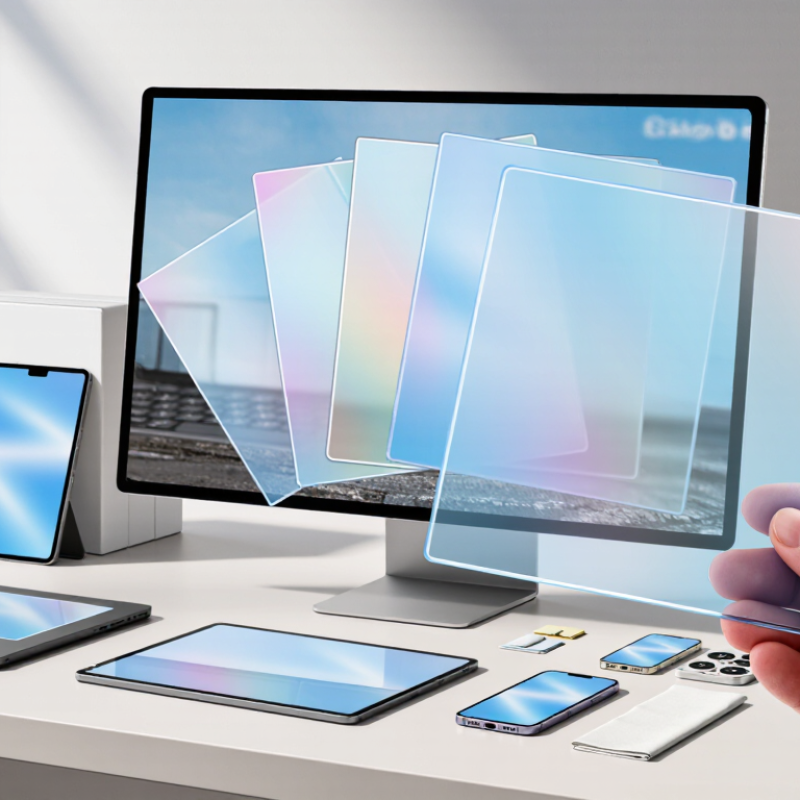
What Anti-Blue-Light Screen Protectors Are and How They Work
An anti-blue-light screen protector is a thin layer placed over a phone, tablet, or monitor. It is designed to reduce some short-wavelength blue light reaching the eyes. Blue light is also present in daylight, so a filter does not make a screen “blue-light-free.”
Many protectors use tinted material or an optical coating that absorbs or reflects part of selected wavelengths. The amount filtered varies with the material, thickness, and viewing angle. A warmer, slightly amber display may be noticeable, but appearance alone cannot verify performance. Some protectors also reduce glare, which is a separate feature. Not a complete shield. Current evidence does not establish that these protectors reliably prevent digital eye strain; long viewing sessions, glare, and infrequent breaks can also contribute to discomfort.
Tips: Check for wavelength and testing details, not just broad filtering claims. Compare the display’s color and clarity before buying, and try a short reading session. If your eyes still feel tired, adjust brightness, reduce glare, and take regular breaks.
Top Anti Blue Light Screen Protector Suppliers - What Anti-Blue-Light Screen Protectors Are and How They Work
| Supplier or Product Category | Typical Product | How Blue-Light Filtering Works | Key Sourcing Checks | Best Suited For |
|---|---|---|---|---|
| Supplier and Product Comparison | ||||
| Optical glass protector manufacturers | Tempered glass protectors with an applied optical coating or a filter incorporated into the glass structure. | The coating or material selectively reduces transmission in specified parts of the visible spectrum. Filtering performance depends on the product design and wavelength tested. | Request a wavelength-by-wavelength transmission curve, visible-light transmission data, coating durability information, and device-specific fit details. | Buyers seeking a rigid, scratch-resistant screen layer with documented optical specifications. |
| Polyester film converters | Thin PET film protectors, commonly supplied in clear, matte, or coated finishes. | A filter layer or tint can reduce transmission in selected blue-violet wavelengths. A visible tint may affect perceived screen color. | Check optical data, haze, surface finish, adhesive compatibility, cut accuracy, and whether measurements are for the finished film rather than the base material. | Bulk orders, lightweight protection, and applications where flexible film is preferred. |
| Flexible polymer film suppliers | Flexible TPU or similar polymer protectors, often designed for curved displays. | Blue-light reduction, when offered, comes from the film formulation or an added optical layer; it is not an inherent property of every flexible film. | Confirm the exact polymer, clarity, scratch-recovery claims, installation method, and independent test results for the filtering specification. | Curved screens or devices where a flexible protector is needed. |
| Privacy-filter manufacturers | Removable or adhesive privacy filters, sometimes combined with a blue-light-filtering feature. | Microlouver privacy structures limit viewing angles. Any blue-light filtering is a separate optical feature and should be verified independently. | Ask for viewing-angle and light-transmission data, the filtering test method, screen-size compatibility, and whether touch operation is supported. | Shared workspaces, public settings, and users who need viewing-angle control as well as a screen filter. |
| OEM and ODM screen-protector suppliers | Custom-made protectors produced to a buyer’s material, size, coating, packaging, or labeling requirements. | Filtering performance depends on the specified film, glass, coating, and manufacturing process selected for the order. | Agree on a test protocol, sample approval, production tolerances, quality-control records, and batch-to-batch verification before ordering. | Retailers and distributors seeking custom specifications or private-label production. |
| What the Product Does and How to Evaluate It | ||||
| Meaning of “blue light” | Part of the visible-light spectrum, commonly discussed as roughly 400–500 nm; exact band definitions vary by context. | A screen protector can attenuate some wavelengths by reflecting or absorbing light, depending on its optical materials and design. | Compare products using the same stated wavelength range and test method; a single percentage without these details is difficult to interpret. | All buyers comparing optical-filter claims. |
| Filtering-performance evidence | Spectral transmission data for the finished protector, ideally measured across the relevant visible wavelengths. | A transmission curve shows how much light passes through at different wavelengths. Results can differ between products and test conditions. | Request the test report, instrument or method details, sample configuration, and visible-light transmission alongside any blue-light figure. | Procurement teams evaluating product claims or comparing suppliers. |
| Color and brightness effects | Appearance varies from nearly clear to visibly warm or tinted, depending on the filter design. | Reducing selected visible wavelengths can change color balance or screen brightness; the extent varies by product. | Review physical samples on the intended device and assess color rendering, readability, touch response, and fit. | Users who prioritize color accuracy or frequent screen viewing. |
| Health and comfort claims | Marketing may describe a product as reducing blue light or improving visual comfort. | Filtering is an optical function; it does not by itself establish a medical benefit. Evidence for reducing digital eye strain or preventing eye disease should not be inferred from a filtering percentage. | Use appropriately qualified claims and ask suppliers for substantiation relevant to the exact finished product. | Suppliers and buyers preparing accurate product descriptions. |
Note: Blue-light filtering performance is product-specific, and there is no single percentage that can be used to compare every protector. Ask suppliers for spectral transmission data and the test method, and evaluate samples for clarity, color shift, touch response, fit, and durability.
Share On: